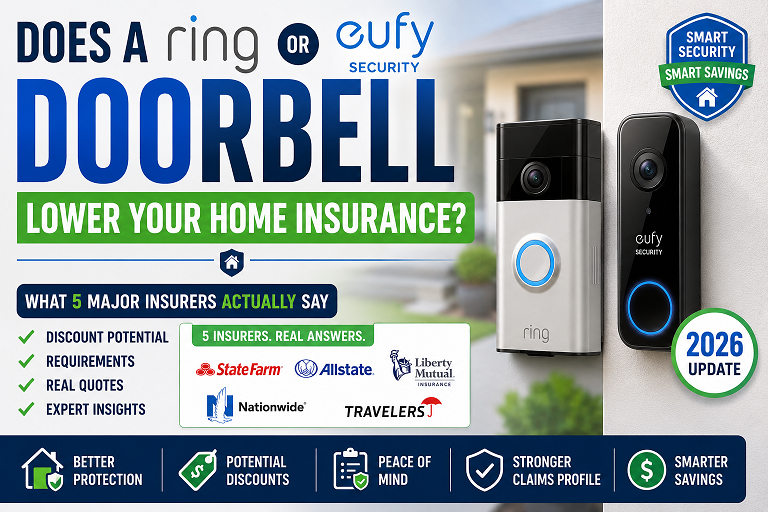
Does a Ring or Eufy Doorbell Lower Your Home Insurance? What 5 Insurers Actually Say (2026)
A Ring or Eufy doorbell alone rarely qualifies for a meaningful homeowners insurance discount. Most insurers offering discounts above 5% require professional monitoring — not just a camera. A Ring doorbell with a Ring Protect Pro subscription (which adds 24/7 professional monitoring at $20/month) does qualify at State Farm, Allstate, USAA, and others. Eufy cameras are self-monitored and local-storage-based, which almost never qualifies for the larger discounts. The exception: American Family Insurance has a direct Ring partnership offering a 5% discount just for owning a Ring doorbell, no monitoring required. The national average homeowners insurance premium is $2,300/year in 2026 — a 10% discount is worth $230/year, which more than covers Ring’s monitoring cost.
The question “does a Ring doorbell lower my insurance?” has been floating around smart home forums for years — and the answer most people find is either “yes, up to 20%!” or “no, it doesn’t qualify” — both technically true depending on which insurer you ask and what your setup actually looks like. The confusion exists because insurance companies don’t discount the camera. They discount the monitoring.
This guide cuts through the noise: here’s what each major insurer actually offers, why Eufy’s self-monitoring model is treated differently than Ring’s optional professional monitoring, and whether the math makes sense for your situation before you call your agent.
The Honest Answer: It Depends on Monitoring
Here’s the core distinction that explains most of the confusion: insurers reduce premiums for monitored security systems because they lower claim risk. A home with 24/7 professional monitoring — where a central station dispatches police or fire on your behalf if an alarm triggers — is statistically less likely to suffer large, undetected losses. That’s the risk reduction insurers are actually rewarding.
A doorbell camera, whether Ring or Eufy, is a recording and notification device. It doesn’t dispatch anyone. It shows you who’s at the door on your phone. That’s valuable for many reasons — but from a claims-risk perspective, it’s only marginally different from having no camera, unless it’s part of a broader monitored system.
| Security Setup | Typical Discount Available | Why |
|---|---|---|
| Doorbell camera only (self-monitored) | 0–5% — varies by insurer | Minor deterrence value; no dispatch capability |
| Basic alarm system (no monitoring) | 2–5% | Deterrence and alerting, but no professional response |
| Monitored alarm system (professionally monitored) | 5–15% | Active 24/7 response — reduces likelihood and size of claims |
| Monitored system + fire/smoke/water detection | 10–20% | Covers multiple claim types — theft, fire, water damage |
| Monitored system + combination of smart devices | Up to 20% at some carriers | Stacked discounts across security, fire, and water categories |
The Key Term: Professional Monitoring
Professional monitoring means a UL-listed central monitoring station watches your system around the clock and calls police, fire, or medical services on your behalf when an alarm triggers — even if you’re asleep, traveling, or your phone is dead. This is what most insurers actually discount. Self-monitoring (you get an alert on your phone and decide what to do) almost never qualifies for the larger discounts, no matter how sophisticated the camera is.
What 5 Major Insurers Actually Offer
Discount for Ring doorbell alone: ~5% — one of the only major insurers to offer a meaningful discount for a self-monitored Ring doorbell without requiring professional monitoring. American Family has a direct partnership with Ring: customers get $30 off the Ring device purchase, and installing a Ring doorbell qualifies for approximately a 5% policy discount. They’ll also reimburse your deductible if you suffer a break-in after installing the Ring system.
Self-monitored (Ring/Eufy camera only): up to 5% through partnerships with select brands (including Canary, historically). Professionally monitored system: up to 20% — one of the higher maximums among major carriers. Allstate also offers a connected home discount program and has varying state-level partnerships.
Professionally monitored alarm: up to 15%. State Farm also has a unique program with Ting — a free smart plug that monitors your home’s electrical network for fire hazards. The free Ting device (worth $29.99) is available to State Farm customers at no cost, though it cannot be stacked with a policy discount. State Farm’s security discounts require a monitored alarm system — a doorbell camera alone doesn’t qualify. State Farm has also historically had relationships with ADT Pulse, and its Canary partnership gives customers discounts on the Canary device and homeowners/renters insurance.
Monitored security system: 5–10% depending on state. Liberty Mutual has partnered with Vivint to offer customers $100 off select smart home devices. Liberty Mutual’s Nest program (available in select states including AL, CO, DE, IL, KY, ME, MN, PA, UT, WI) provides additional smart home integration. Exact discounts vary significantly by state — call your agent for your specific location’s applicable discount.
Connected home discount: up to 15% for monitored systems. USAA offers its members discounts on equipment from multiple partners: ADT (10% off monthly monitoring, 15% off hardware), SimpliSafe (50–60% off starter kits depending on package), and Roost. USAA’s connected home discount is not available in Hawaii, New York, North Carolina, or South Carolina. The discount amount isn’t publicly specified — it varies by state and policy.
Ring vs. Eufy: Why the Monitoring Model Matters
| Ring (with Protect Pro) | Eufy (any plan) | |
|---|---|---|
| Professional monitoring available? | Yes — via Ring Protect Pro ($20/month or $200/year) | No — Eufy is self-monitored and local-storage-based |
| Insurance monitoring certificate | Yes — Ring provides a Professional Monitoring Certificate you can submit to insurers | Not available — no central monitoring station to issue a certificate |
| Qualifies for large discounts (10%+)? | Yes — with active Protect Pro subscription | No — self-monitoring only |
| Qualifies for small discounts (2–5%)? | Possibly — American Family has direct Ring partnership; others may vary | Possibly — a small number of regional carriers may offer a minor credit for any camera system; not common |
| Monthly cost for discount eligibility | $20/month (Protect Pro) — required for professional monitoring | $0 — but without monitoring, discount eligibility is minimal |
Eufy’s No-Subscription Advantage Comes at an Insurance Trade-Off
Eufy’s strongest selling point — local storage, no monthly fees, no cloud dependency — is also the reason it rarely qualifies for meaningful insurance discounts. Insurers reward the monitoring contract because it represents a verifiable, ongoing commitment to security response. A self-monitored camera with local storage is excellent for privacy and data control; it just doesn’t translate to insurer risk reduction the same way a monitored system does. If insurance discounts are a priority, Ring Alarm with Protect Pro is the more direct path — and the discount can offset the monitoring cost at most policy sizes.
The Real Math: Is the Discount Worth the Monitoring Cost?
The national average homeowners insurance premium is approximately $2,300/year in 2026. Here’s what different discount tiers actually mean in dollar terms — and how they compare to Ring’s monitoring cost:
Based on $2,300/year national average premium (2026) and Ring Protect Pro at $200/year. Your actual premium and discount percentage will vary by insurer, state, and policy. Always confirm your specific discount with your agent before making decisions.
The Break-Even Point Is Lower Than It Looks
At a 10% discount, the insurance savings roughly cover the entire Ring Protect Pro subscription cost. At 15%, you’re net positive. But the more important reframe is: if you’d already pay for Ring monitoring for the security benefit (peace of mind, professional response when you’re away), the insurance discount becomes essentially free money on top of something you were already paying for. The math becomes very favorable when you stop treating the monitoring cost as a line item you’re adding just for insurance, and start treating it as security spending that also happens to earn a discount.
How to Actually Claim Your Discount
Activate Professional Monitoring on Your System
For Ring: subscribe to Ring Protect Pro ($20/month or $200/year) — this is the plan that includes 24/7 professional monitoring. For other systems (SimpliSafe, ADT, Abode, Vivint), make sure your professional monitoring plan is active before proceeding.
Obtain a Professional Monitoring Certificate
For Ring: go to support.ring.com and search “professional monitoring certificate” — there’s a Help Center page that walks you through requesting it. The certificate documents your active monitoring subscription and central station details. This is the document your insurer needs.
Call Your Agent — Don’t Email
Security discounts often require a direct conversation because they vary by state and coverage type. Call your agent, say “I have an active professionally monitored security system and I’d like to apply any applicable burglar alarm or security system discount to my policy,” and ask what documentation they need. Have your monitoring certificate ready.
Ask About All Applicable Discount Categories
Don’t stop at the security discount. Ask your agent: “Are there separate discounts for fire/smoke detection? Water leak detection? A combination of devices?” Stacking discounts across categories — security, fire, and water — is how you reach the higher end of a carrier’s total available discount.
How to Maximize Your Discount Beyond the Doorbell
A Ring doorbell or Eufy camera is one piece of a larger picture. These additional devices — paired with a monitored alarm — typically stack to increase your total discount:
- Smart smoke/CO detectors (Nest Protect, First Alert Onelink): Fire detection discounts are often separate from burglar alarm discounts — you may be able to claim both. Up to 5% for smoke/fire detection at many carriers.
- Water leak sensors (Resideo, Phyn, Flo by Moen): Water damage is one of the most expensive claim types. Several carriers — including Nationwide (up to 10% off for enrolled monitoring) and USAA (Resideo partnership) — offer separate water leak detection discounts.
- Smart lock: Documented access control (who entered your home and when) can supplement a security claim but rarely earns a standalone discount — include it in your overall security setup description to your agent.
The combination that maximizes discount potential across most carriers: monitored alarm + professional monitoring certificate + smart smoke/CO detection + water leak sensor. At Allstate, this combination can reach 20%. At most carriers, 15%+ is achievable with the right documentation.
See Which Smart Home Devices Earn the Largest Discounts
Our full guide covers every smart home device category that qualifies for insurance discounts — cameras, locks, smoke detectors, water sensors, and thermostats — with discount estimates by device type.
Frequently Asked Questions
Does a Ring doorbell lower homeowners insurance?
A Ring doorbell alone — self-monitored — typically earns a small 2–5% discount from a handful of insurers, with American Family being the clearest example via its direct Ring partnership. The meaningful 10–20% discounts require professional monitoring, which Ring offers through Ring Protect Pro ($20/month). With that subscription active, you can obtain a professional monitoring certificate from Ring and submit it to your insurer to qualify for larger security discounts at State Farm, Allstate, USAA, and others.
Does a Eufy camera lower homeowners insurance?
Eufy cameras are self-monitored and local-storage-based with no central monitoring station, which means they almost never qualify for meaningful homeowners insurance discounts. A small number of regional carriers may offer a minor credit (2–5%) for any camera system, but this is not common or consistent. Eufy cameras can contribute to a discount when they’re part of a broader setup that includes a professionally monitored alarm — but the monitoring is what the insurer is rewarding, not the camera itself.
Which home insurers offer discounts for smart doorbells?
American Family Insurance has a direct Ring partnership offering approximately 5% off for Ring doorbell owners without requiring professional monitoring. Allstate offers up to 5% for self-monitored systems and up to 20% for professionally monitored setups. State Farm offers up to 15% for monitored alarm systems. Liberty Mutual offers 5–10% by state. USAA offers a connected home discount for members with monitored systems and has partnerships with ADT and SimpliSafe. Exact percentages vary significantly by state — always confirm with your specific agent.
What is the difference between self-monitoring and professional monitoring for insurance?
Self-monitoring means you receive alerts on your phone and decide whether to call 911. Professional monitoring means a UL-listed central station watches your system 24/7 and dispatches emergency services on your behalf. Insurers discount professional monitoring because it reduces claim risk — faster response means smaller losses. Most meaningful discounts (10–20%) require professional monitoring. Self-monitoring alone typically earns 2–5% from a small number of carriers.
How do I get an insurance discount for my Ring system?
Activate Ring Protect Pro ($20/month or $200/year), which includes 24/7 professional monitoring. Then request a Professional Monitoring Certificate from Ring via the Ring Help Center — this document proves active professional monitoring to your insurer. Call your agent, mention you have a monitored security system, and ask them to apply any applicable security discount. Have your monitoring certificate ready to submit.
Is the insurance discount worth the cost of a Ring subscription?
At a 10% discount on the $2,300 national average premium, you save $230/year. Ring Protect Pro costs $200/year — that’s $30/year net savings at 10%. At 15% ($345 savings), you’re ahead by $145/year. The math is most favorable if you’re already paying for Ring monitoring for the security benefit — in that case, the insurance discount is essentially free savings on top of a cost you’d incur regardless. If you’d only add monitoring for the insurance discount alone, run your specific numbers with your actual premium and your insurer’s confirmed discount percentage first.
Related Guides
- Abode — Home Security Insurance Discount 2026: How to Save 5–20% (June 2026)
- Insurify — Comprehensive List of Home Insurance Discounts 2026 (June 2026)
- ValuePenguin — Are Smart Home Devices Worth the Insurance Discount?
- SmartFinancial — Smart Home Devices: Discounts for Secure Home Living
- Level — How Smart Home Devices Can Earn Insurance Discounts (September 2025)
- Ring Support — How to Get a Professional Monitoring Certificate for Your Insurance Company
- Abode — How Much Does a Home Security System Save on Insurance?